Pattern Recognition
Compare examples to spot what repeats or changes in a predictable way. Use the pattern to predict what comes next.
Try the example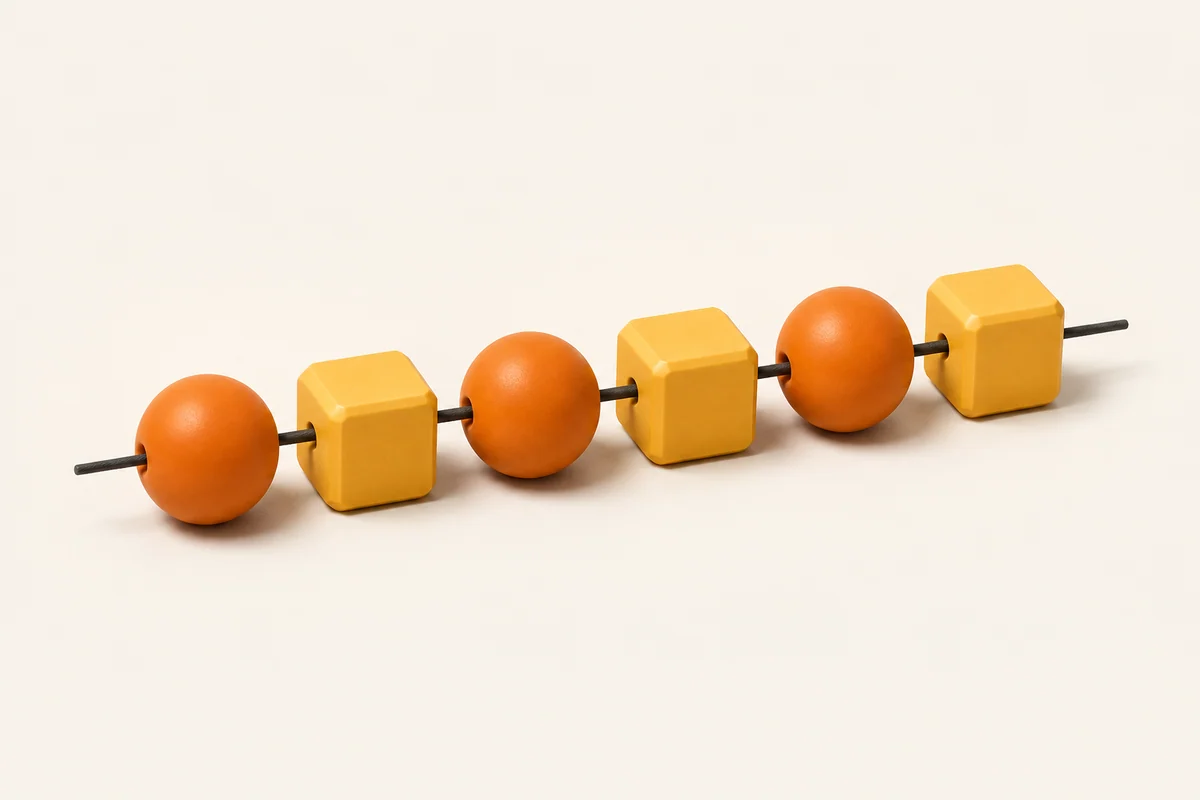
Which bead comes next?
Look along the row of beads. What would you need to know to keep threading it the same way?
Compare neighbouring beads
A sphere is followed by a cube. Both shapes appear several times along the row.
How to find the pattern
Compare several cases
Track shapes, order or actions. Problems that look different can still have the same structure.
Describe the relationship
Say what repeats or how each value changes. In the sequence 2, 5, 8, 11, each number increases by 3.
Check another case
Predict the next case and compare it with what actually happens. If the prediction fails, revise the rule.
The same structure in different places
A rhythm
Two claps and a rest form a group. Recognising it tells you when to clap again.
Comparing data
Comparing several weeks of temperatures may reveal a recurring rise and fall. Check whether later measurements follow it.
A loop
If the same two drawing commands keep appearing together, put the pair inside a loop.
How the skills connect
You spotted the repeating pair of beads. To predict the next shape, it is enough to remember “sphere, cube”. You can leave out the colour and size of each bead. Choosing just the details you need is abstraction.